I co-founded a video production operations platform. As CTO, I designed the policies and UX connecting intake, production, review and settlement, and built most of the frontend and backend with AI development tools.
Role
Co-founder · CTO
Status
Ongoing
People
Clients, planners, creators and operators
Scope
Product direction, system architecture, UX/UI and development
Founding team
Three co-founders · CEO, CMO and CTO
PRODUCT OWNERSHIP / OPERATING SCALE
Designed and built the workflow from intake to settlement.
Workflow
Connected intake, role-based production, review and settlement in one operating workflow.
My implementation
Owned product policy, architecture and UX; built most frontend and backend features with AI-assisted tools.
Operating scale
59 ongoing projectsOperating dashboard, September 24, 2026.
INTAKE / BEFORE & AFTER
From product tags to step-by-step questions.
Source & problem
Inquiries I handled repeatedly showed that clients struggled to choose among internal product tags. No verbatim quote or inquiry count is available.
Decision
Let clients describe the request in their own words, then have intake classify it and ask for missing production details.
Current result
The conversational screen is implemented in code. The captures below use sample data; production rollout timing and any measured impact are unverified.
These screens compare a product-tag selector with a step-by-step intake flow. The revised screen shows a brand-name question, not AI product classification. The captures use different sample requests and illustrate the interface approaches rather than the same request before and after.
01 / Earlier approach — clients interpret production categories and product tags themselves. Reproduced from the 11 August 2026 branch component with sample data.02 / Revised approach — clients answer questions and provide details step by step. Conversational intake UI from the 18 September 2026 code, rendered with sample data.
Source and reproduction details
Earlier component: chore/staging-snapshot-before-main-sync-20260811 · e1e8191. Conversational UI: 60f5259. Both captures use sample data; they are component demonstrations, not historical production screenshots or evidence of AI classification accuracy.
The August branch also contains conversational intake code. Its date establishes that this tag selector existed in the repository; it does not establish the production rollout sequence.
01 / DECISIONS
What I prioritized, and why.
01 / Move classification from the client to the product.
One person handled support, so capacity had to be managed. Direct support work showed me that clients struggled with our product categories. I prioritized changing intake to reduce the need for repeated explanations.
Conversational intake checks for required production information and asks follow-up questions. This shifts responsibility to the product: clients need a way to correct automatic answers and continue when extraction fails.
Implemented correction and recovery paths
02 / Give every production task an owner and a handoff.
I gave planning, filming and editing their own owners and status. Eligible freelancers accept each task; approvals and submitted materials trigger the next handoff.
More roles require consistent materials and handoff conditions. Approval checks and operational handling for unassigned work remain necessary.
Role model and architecture
The data model separates owners, status and candidates. Implementation includes acceptance checks, next-role selection after planning approval and editor notifications after footage submission.
01 / Responsibilities and handoffs · design diagram02 / Shared workflow and system structure · design diagram
03 / Give clients a reason to respond promptly.
I developed notifications and a scoring system, offering faster handling and price benefits to clients who sent revision requests promptly. This client incentive policy did not penalize low scores.
The operational target was feedback within three hours, to reduce freelancers’ waiting time. The response-target achievement rate and the cost of the incentives have not been established in this case.
04 / Track production time to prioritize AI adoption.
Using SQL, I queried and aggregated the time from request submission to first draft, and from feedback receipt to implementation of requested changes. Comparing the two helped me prioritize which stages to assess for AI adoption.
This analysis informed AI adoption priorities; it does not represent measured time savings after adoption.
SELIT / COLLABORATION
From production experience to AI pre-review.
I turned the review criteria shared by a co-founder into a product feature.
01 / PRODUCTION CRITERIA
Co-founder · Video production experience
What needs checking?
Shared the checks clients care about: spelling, scene order and whether requested changes are reflected.
02 / PRODUCT IMPLEMENTATION
Dohyeon Kim · Product planning and implementation
A check before review.
I designed and implemented an AI feature to check these items before review.
03 / CURRENT STAGE
AI pre-review · In testing
Aim: fewer review rounds.
The aim is to catch basic omissions early and reduce avoidable revision requests and repeated reviews.
In testing
A reduction in review rounds or an improvement in checking accuracy has not yet been established.
02 / CONNECTED WORKFLOW
From the request to production and review.
Intake connects to role-specific acceptance, handoffs, files, notifications and settlement in the operating platform.
Production type
Choose the production scope in language clients understand.
Captured locally on Sep 28, 2026 from current source components. The demo shell, names, prices, deadlines and feedback are fictional. Saving, sending and uploads are disabled. Select a screen to enlarge it.
Explore the production deliverables library
DELIVERY → LIBRARY → NEXT BRIEF
Completed work becomes the next reference.
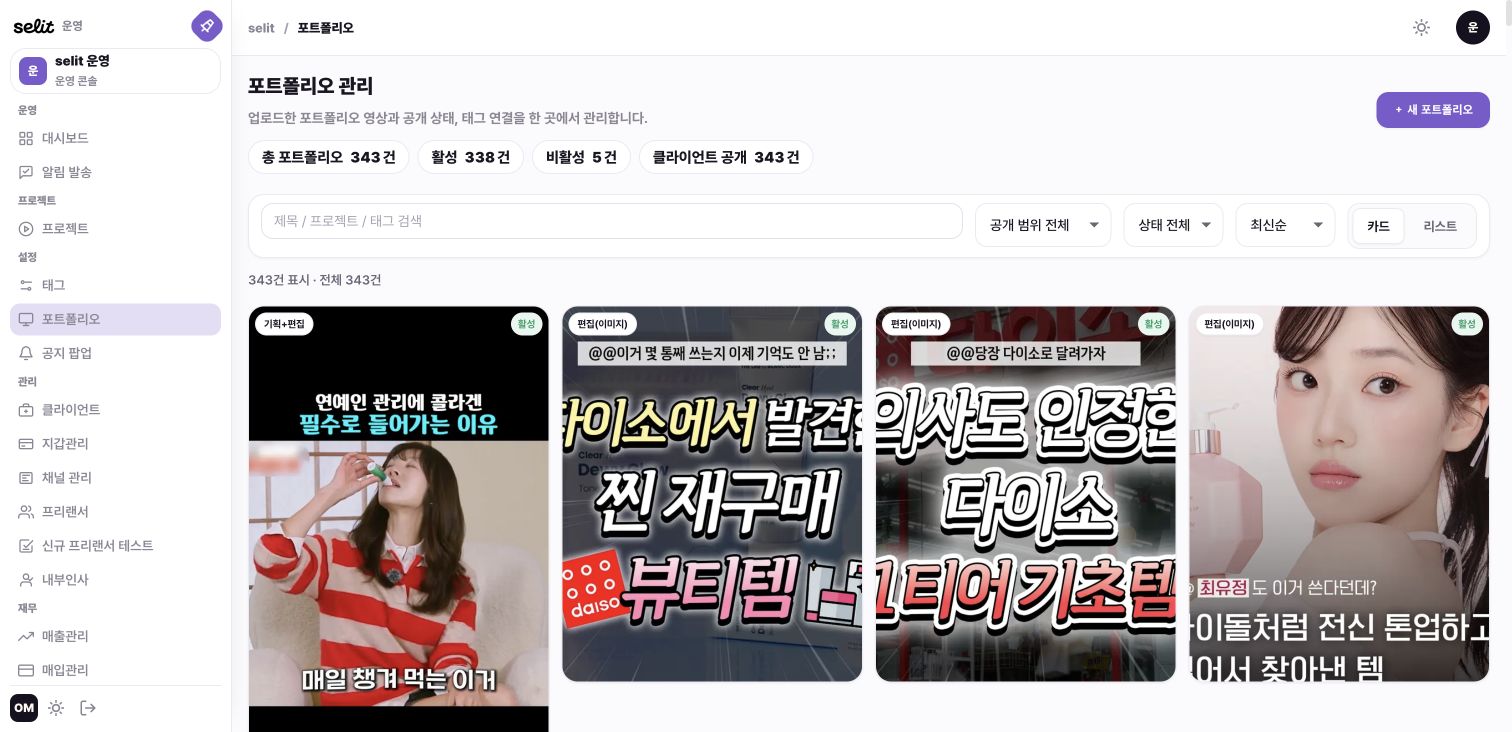
The admin library brings videos and image carousels together with project context, tags and visibility. The client portal then makes that work browsable.
SELIT / ADMINActual product
Production capture · Sep 16, 2026. Portfolio items are separate from monthly completed projects.
Reading the Korean interface: each card is a completed video or image carousel. Project details and tags preserve its context; visibility controls determine what appears in the client portal. The media shown here was created by production teams. I built the platform that organizes it.
01 / ORGANIZE
Keep the production context.
Project, content type and tags make the output reusable as a reference.
02 / CURATE
Control what clients see.
Visibility and active status separate the library from the client-facing selection.
03 / EXPLORE
Preview first, open when needed.
Thumbnail and short-preview fields are separate from full playback in the product code.
Shown work was produced by teams through SELIT. My contribution was the platform’s product structure, role-based UX and implementation.
03 / EVIDENCE & LEARNING
Results and next questions.
Sources and measurement limits
The operating count above comes from a supplied dashboard capture, without a database audit. The original capture is not published. The founder recalls the intake change on August 12, 2026; the rollout sequence was not verified against deployment records.
As supporting context only, I retrospectively estimate daily KakaoTalk support at about four hours before and one hour after the change. This was not measured from time logs. The comparison period, observed days, request volume and follow-up rate are unavailable, so the estimate is not presented as a core outcome.
What I would measure next
Compare support time per submitted request alongside total workload, and check how often intake needs follow-up or correction. This would help distinguish less support work from simply fewer requests.